Observations
One journey.

Where the Spaces Meet
The experience that gave rise to the photographic question
Travelling through Japan on the Shinkansen, I find myself in a peculiar spatial condition. My body remains almost still, enclosed within a room that carries me through the landscape at extraordinary speed. The seat, the window, the objects around me remain available to my attention. Within this moving enclosure, I experience a fragile sense of continuity.
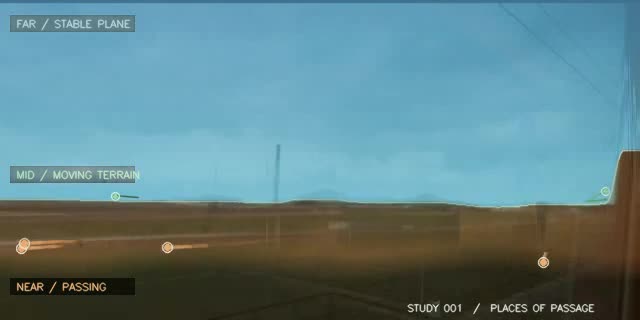
Beyond the window, another spatial reality unfolds. Trees rush past, settlements appear and disappear, fields glide out of sight. I traverse these places without being able to remain with them. Strangely, the distant horizon offers greater perceptual continuity than the environments closest to me.
I become aware of three experiential horizons: my inner sense of space, the space in which I travel, and the space through which I travel. They coexist, yet resist being brought together into a single coherent experience.
The window becomes the point at which these horizons meet and rub against one another. Through it, I see a world I am physically moving through but cannot inhabit. Its reflections mingle with the interior, while the landscape continually escapes my gaze.
Trying to draw
what it felt like
A deliberately provisional, retrospective sketch of the spatial experience: inner awareness, the moving carriage and the landscape beyond.

Three spaces, one relation
in the making
The tentative lines of the sketch become a moving perspective. The film shifts between the space I sense within myself, the carriage that carries me and the landscape through which I travel.
— continued
Sound as an experiential horizon
Yet there is another experiential horizon: sound.
The continuous hum of the train, its mechanical rhythms and vibrations, the air moving around it, the sounds of fellow passengers. These are not merely sounds inside the carriage. They emerge through the material conditions of travelling: the encounter between train, infrastructure, atmosphere and environment.
While the landscape continually slips away from my vision, the sound of travelling remains with me. It carries something of the journey's material conditions into the space I inhabit.
At the window, these different ways of experiencing the world become entangled. What I see, what I hear, what I feel and where I understand myself to be do not entirely coincide. Yet none of these experiences arises independently of the conditions of the journey.
This tension gives rise to a photographic question.
What if the sound of travelling could participate in the formation of the photograph?
What if the camera did not merely register the passing landscape, but allowed the sonic conditions of travelling through it to influence how its image comes into being?
Rather than adding sound to an already formed image, I began to wonder whether sound could become materially operative within photographic formation itself.
The photograph might then become more than an image of the landscape passing outside the window. It could become a trace of the encounter between the environments through which I travel, the infrastructure that carries me, and the conditions through which I perceive them.
Intra-action
From Experience to Intra-action
Karen Barad's concept of intra-action offers a way of reconsidering this experience. Rather than understanding the traveller, the train and the landscape as separate entities that subsequently enter into relation, intra-action directs attention towards the material conditions through which particular boundaries, properties and possibilities of relating emerge.
From this perspective, the window is not simply a transparent boundary separating an observer from an external world. Together with the train's movement, its infrastructure, the light, sound and bodily conditions of travelling, it participates in organising what can be perceived, what remains present and what passes beyond attention.
My photographic experiment begins by intervening in this arrangement.
By allowing sound recorded inside the train to modulate the formation of an image captured outside, I introduce another relation into photographic production. The resulting image is shaped not only by the light arriving from the landscape, but also by the sonically registered conditions of travelling through it.
Photography becomes a site where these different material conditions acquire consequences for one another.
The question is no longer simply what the photograph represents, but what relations become materially operative in its formation.
Theoretical reference: Karen Barad, Meeting the Universe Halfway (2007).
Another relation.
Not a next step in a sequence, but something this encounter shares with work elsewhere.
 RESEARCH / SHINKAN
How the observation continues
Return to the larger constellation of experiments, apparatuses and open questions.
Follow this relation ↗
 WORK / UNFIXING HORIZONS
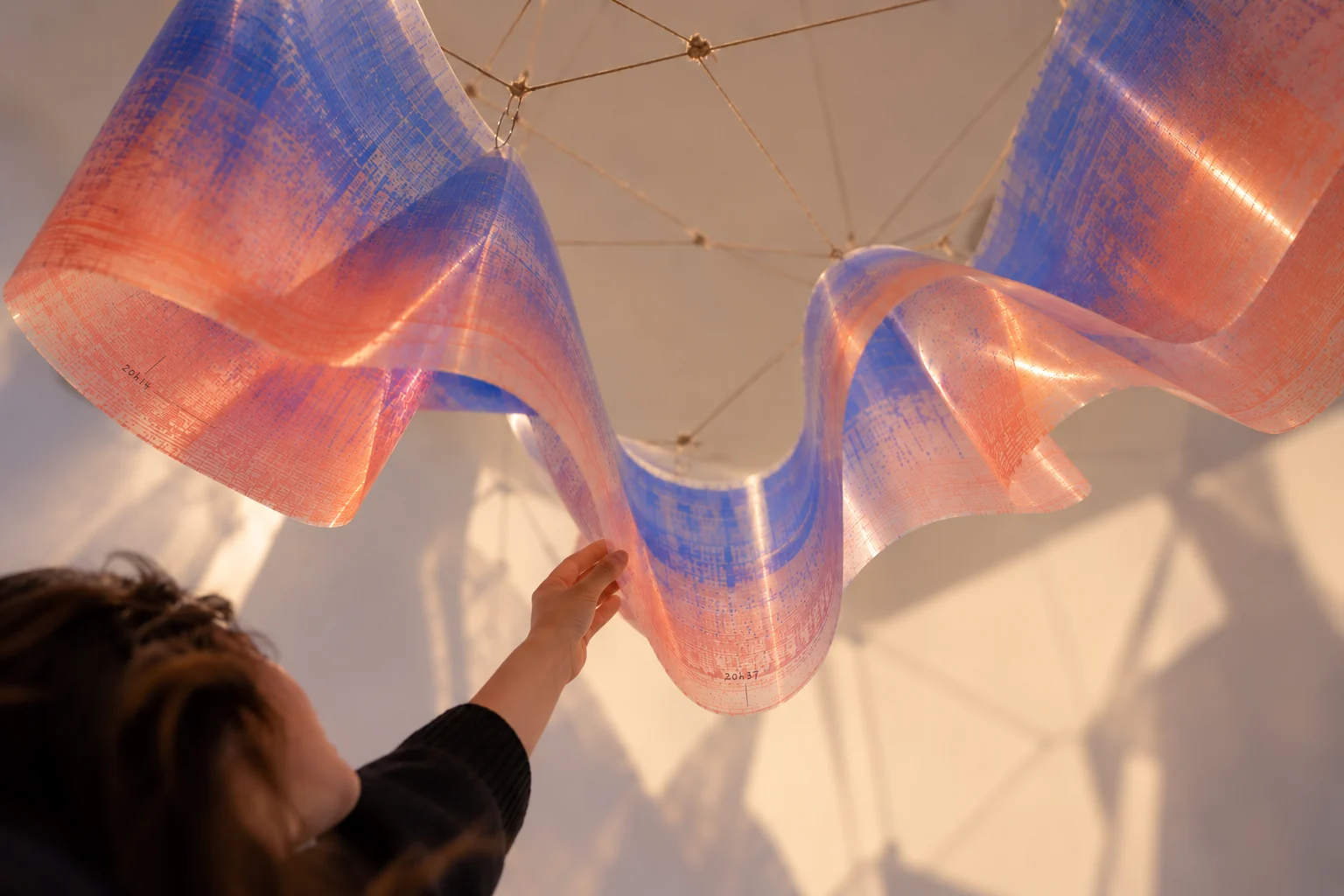
An image encountered differently
Another enquiry into photography, movement and the conditions of seeing.
Follow this relation ↗
The main navigation remains available. You can follow a connection without losing your place.